Hal Crowther an Infuriating American the Incendiary Arts of H L Mencken
Crowther, Hal. An Infuriating American: The Incendiary Arts of H. L. Mencken. Iowa City: University of Iowa Press, 2014.
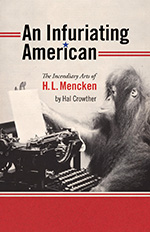 Placing any sort of faith in a book'southward back-cover description of itself is a risky business concern. However on this occasion it is refreshingly apt. Hal Crowther's study of the infamous Henry Louis Mencken is outlined equally "a tribute—though by no means a loving 1—to a behemothic from ane of his bastard sons". Crowther, an accomplished journalist, won the Baltimore Sun'south H. L. Mencken Writing Award in 1992. The implication of, at least a trivial, metaphorical shared blood is evident in the journalistic prowess of both subject and author, notable throughout this curt, sharp burst of a book. Facing a approved writer with an intimidating wealth of existing scholarship can, at times, beg the question: what is really left to say? Mencken certainly falls into this category, a fact acknowledged in the "Disarming Introduction to an Alarming American". All the same, in just lxx-vii pages, Crowther manages to offering a valuable and engaging contribution to the word of an extensively discussed human being.
The book reads more like a collection of journalistic articles than an extended piece of work of literary criticism, although this is not to diminish what is undoubtedly a thoroughly-researched and idea-provoking book. At the end of the brief introduction Crowther instructs his readers to, "Pick upwards your hazmat suits and state-mine detectors at the gatehouse here, and follow me, if y'all're so inclined" (thirteen). The conversational prose, generously peppered with metaphors, makes extensive use of journalistic tropes. Thus the short text is compellingly readable. For Mencken, a man who proposed "to euthanize PhDs and bury them in common graves" (50) it is probable this style would have appealed more than any overtly academic word of his piece of work. Non only "infuriating" but as well ceaselessly infuriated, Mencken ruthlessly derided not only intellectuals, only nigh every possible icon, aspect, and grouping present in American society. Information technology becomes credible that the "hazmat suits and land-mine detectors" may well be necessary.
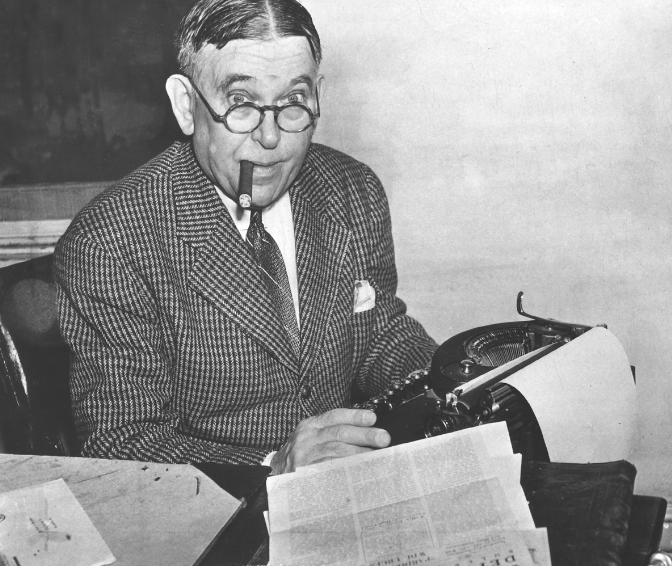
H. L. Mencken: Writer. Mencken, born Henry Louis Mencken in Baltimore in 1880, is known as the "Sage of Baltimore." He worked as a author for the Baltimore Sun from 1905 until 1948. (Robert F. Kniesche/Baltimore Sunday) Image Source: http://darkroom.baltimoresun.com/2012/04/the-suns-175th-anniversary-personalities-through-the-years/bs-bs-wb-menken-e/
The scope of Mencken's work is staggering, "ten million recorded words by his own reckoning" (i), making the accomplishment of this volume all the more impressive. Crowther arranges his work around thematic chapters, equally opposed to an impossible assay of the entire corpus, contextualising and interrogating the human, his piece of work, and American culture. In "Motorcar Dreams", the first of four curt chapters, Crowther situates the "devout technophobe" in relation to the simply invention—aside from the Pullman car—Mencken claimed was e'er of any use to him: the typewriter. Highlighting the historical importance of the typewriter, Crowther positions information technology as "a clever piece of engineering science but essentially a democratic hand tool well-nigh anyone could learn to use" (17). Entry into word of Mencken in this manner situates him in a time "when building a paragraph sounded like building a fence, and required almost every bit much physical effort" (17). Mencken, the typewriter, and the newspaper century are rightly positioned as inextricably linked; communicating at once the vigour, rebellion and aggression of all. While the wealth and political ascendancy of the newspaper historic period was wielded by tycoons such as William R. Hearst, "its ringing voice, its master of ceremonies—the Rex Kong of the Keyboard, the Napoleon of the Newsroom—was the atypical Henry Louis Mencken" (19).
Mencken's fury, wit and controversy are chop-chop brought into focus in the capacity that follow. "Aroused with His Own Time" questions the origins of Mencken's seemingly endless rage. Crowther tentatively proposes, "An educated guess is that the thing he loathed virtually was optimism" (32). This gauge is simply that, and Crowther does not shy abroad from uncertainty regarding the man himself, pointing out that Mencken "was not only the human who contradicted everyone, but a man who personally embodied a milky way of contradictions" (32). One certainty is that Mencken was outrageously combative. Even so he was "not a man of actions merely a man of words" (59), and it is Mencken's practiced deployment of his arsenal—the American language—which is the focus of the "The Word at War". Simply information technology is perhaps the final affiliate, "'I Remain a Foreigner'", where the hazmat suits prove most necessary. Crowther boldly addresses the numerous prejudices Mencken espoused in his work, but points out Mencken was a "full-service misanthrope" (64), in that he arguably vilified every race, organized religion and ethnic group.
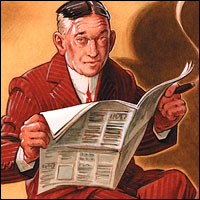
Illustration past Douglas B. Jones
Crowther's determination to provide an unflinching examination of this "Infuriating American" allows for what is perchance this book's greatest strength. In embracing the paradoxical nature of both man and work, and utilising the extensive existing scholarship, Crowther provides a detailed discussion which cements Mencken's continuing relevance. In every chapter, the work of a human "born in the age of the equus caballus and buggy, who lived into the age of hydrogen bombs and nuclear disarmament" (32) is positioned in relation to contemporary America. The consistent context of the nowadays twenty-four hours culminates in the "Recessional", where the age of mass-media is contrasted sharply with that of the typewriter. Framed using Daniel Raeburn's assertion that Henry Louis Mencken was both "the greatest American journalist of the terminal century" and "also an asshole" (71), this concluding discussion gives credit to Mencken'due south immeasurably powerful influence without ignoring his controversy. This book is not a rose-tinted ode to an idol, nor is information technology a Mencken-esque skewering. Instead, it acknowledges the complexities of the man and his piece of work and its contribution to a culture which remains just equally complex.
[starbox]
Other posts in this category:
Source: https://usso.uk/book-review-an-infuriating-american-the-incendiary-arts-of-h-l-mencken-by-hal-crowther/
0 Response to "Hal Crowther an Infuriating American the Incendiary Arts of H L Mencken"
Post a Comment